Introduction: The Myth That Refuses to Die
Every SEO forum, YouTube tutorial, and backlink marketplace seems to promise the same thing — “Get .EDU backlinks for instant authority!”
It’s a persuasive sales pitch. After all, .edu domains belong to universities and government-recognized institutions — websites with deep trust and long-standing history. The assumption is simple:
“If Google trusts them, a link from them will make Google trust me.”
But in 2025, the algorithm doesn’t work that way anymore.
The truth is, most .edu backlinks don’t even get crawled, indexed, or pass a single drop of link juice.
Let’s break this down, layer by layer, and separate myth from measurable SEO reality.
1. The Origin of the .EDU Backlink Craze
To understand the obsession, we have to go back to the early 2000s.
At that time, Google’s PageRank formula heavily emphasized domain trust and link authority. Older, established domains — like universities — naturally had high PageRank scores. When marketers noticed that websites with .edu backlinks ranked higher, they assumed the extension itself carried special ranking power.
This led to an explosion of black-hat link schemes:
Student forums selling “guest post spots” on personal university pages.
Public .edu blogs with open comment sections used for link drops.
Scholarship link-building tactics that had brands offering fake scholarships just to get listed on a school’s page.
And for a short while, it worked.
But Google adapted.
By the mid-2010s, the algorithm stopped assigning “bonus trust” based on domain type alone. It began measuring page-level signals, contextual relevance, and crawl visibility — effectively killing the shortcut that many SEOs relied on.
2. The Technical Reality: How Robots.txt Kills SEO Value
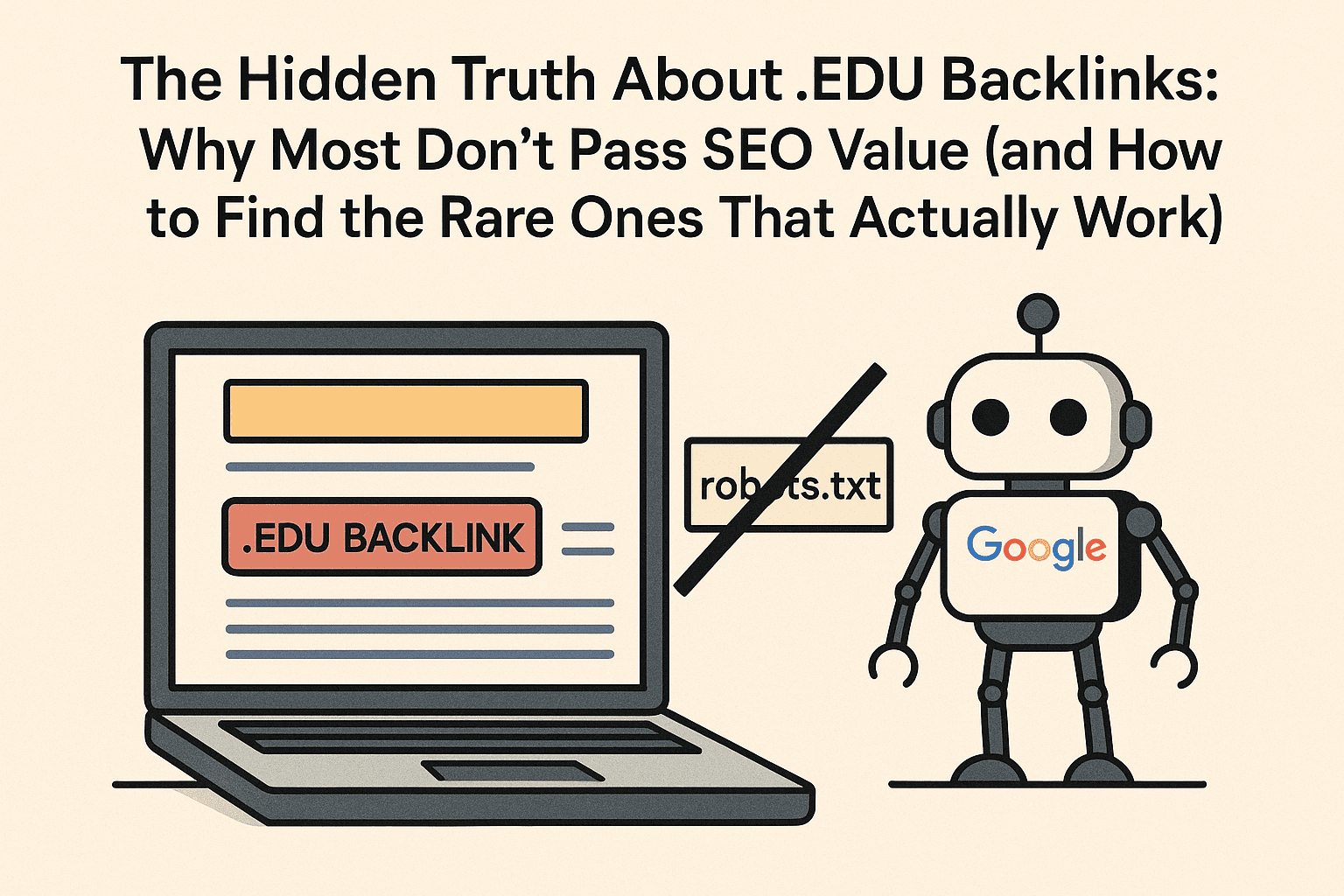
Here’s the part many backlink sellers never tell you: even if your link looks perfect in the source code, it might be invisible to Google.
Every website has a file called robots.txt, located at the root directory (for example: example.edu/robots.txt). This file tells search engines which folders or pages they’re allowed to crawl.
Let’s look at a common university robots.txt example:
User-agent: *
Disallow: /~students/
Disallow: /users/
Disallow: /blogs/
Disallow: /courses/
That simple list of commands means Googlebot and every other crawler cannot access those directories.
So if your backlink sits on a page like example.edu/~john/blogs/resources.html, Google will never crawl it.
No crawl = no index = no PageRank transfer.
It doesn’t matter if the link is “dofollow” or if the site has DA 90 — your backlink is invisible in the eyes of the search engine.
Why universities do this
Universities block these directories intentionally to prevent misuse.
In the past, student pages and club websites were abused by SEOs buying or spamming backlinks. Now, web admins lock them down to protect the university’s reputation and prevent link manipulation.
So when you see “cheap .edu backlinks for $10 each,” remember — 99% of them exist in disallowed folders, making them SEO-dead zones.
3. How to Tell If a .EDU Backlink Actually Counts
Here’s a foolproof process to verify whether your backlink passes SEO value:
✅ Step 1: Check Indexation
Copy the full URL of the page where your backlink appears.
Search it on Google using quotation marks:
"site:example.edu/page-name"
If it doesn’t appear, that page isn’t indexed — and your link isn’t counted.
✅ Step 2: Inspect Robots.txt
Visit the root domain (example.edu/robots.txt) and read through the disallowed paths.
If your backlink lives in one of those blocked folders, it’s game over.
✅ Step 3: Use Google’s Cache or “Inspect URL” in Search Console
Paste the page in Google Search Console or type cache:example.edu/page in your browser.
If you see no cached version, it’s likely invisible to Googlebot.
✅ Step 4: Check Context and Placement
A link buried in a random footer or comment section carries little to no value. But if your link is included contextually — within a paragraph of relevant text — it’s far more likely to pass authority.
4. The Big Misconception: Domain Authority ≠ Page Authority
Most people chase .edu links because tools like Moz or Ahrefs show high Domain Authority (DA).
But here’s what’s often overlooked: Google doesn’t use Domain Authority.
SEO tools estimate DA using their own link graphs, but they don’t reflect how Google evaluates link equity.
In Google’s eyes, every page on a site is independent. A university homepage may have massive authority, but a random, unlinked student blog on a subfolder has almost none.
So, when your backlink appears on:
university.edu/~student123/my-blog-post.html
You’re not getting the DA 90 of the root domain — you’re getting the page-level authority of a nearly orphaned, unindexed URL.
The result? Zero measurable SEO benefit.
5. What Google Actually Values in 2025
Google’s ranking systems now prioritize contextual trust signals, not just raw backlinks.
Key ranking factors in 2025 include:
Topical relevance — Does the linking page align with your content niche?
Crawlability and indexation — Can Google actually see and process the page?
Link context — Is your site mentioned naturally, or is it clearly self-promotional?
User engagement metrics — Pages with real traffic and interaction have more SEO weight.
That’s why a relevant backlink from a small, indexed .com blog about SEO can outperform ten .edu links sitting behind blocked directories.
6. When .EDU Links Still Work (and Are Worth the Effort)
Not all .edu links are dead. Some can still pack serious SEO punch, if they meet specific conditions:
The page is indexed and crawlable.
The link is placed contextually, not stuffed in a random footer.
The content is related to your topic or business.
The .edu site’s internal structure allows link equity to flow.
Example of a valuable .edu link:
A university’s research article citing your case study.
A scholarship listing page that’s publicly indexed.
A partnership or local resource page linking to your business.
These links are rare and often require genuine collaboration, but when you earn one — it’s worth dozens of generic backlinks.
7. Smarter Strategies That Beat .EDU Link Hunting
Instead of wasting time chasing blocked university pages, focus on link strategies that give real, measurable results:
📰 HARO (Help a Reporter Out): Earn links from high-authority news sites.
📝 Guest posting on niche blogs: Quality, relevant guest content drives authority and referral traffic.
📈 Original data or tools: Create something valuable that journalists or bloggers naturally cite.
🌍 Local business directories: Clean, indexed citations strengthen local SEO.
🧠 Expert roundups and collaborations: Networking with thought leaders leads to natural, powerful backlinks.
These strategies build real authority instead of the illusion of it.
8. Final Thoughts: Context Beats Extension
In today’s SEO world, .edu doesn’t mean “automatic trust.” Google no longer rewards backlinks based on domain type — only on relevance, visibility, and authenticity.
If you’re serious about ranking higher, stop chasing extensions. Start chasing context and credibility.
When you focus on links that people actually click — not just ones that exist in code — you build a backlink profile that both users and algorithms trust.
So the next time someone offers you a “high-DA .edu backlink package,” remember this:
The only thing high about it might be the price — not the value.
🧩 Key Takeaways
Concept Explanation
Most .edu backlinks are blocked Robots.txt prevents Google from crawling many student or course pages.
Domain Authority is misleading Google measures page-level relevance, not domain metrics.
Indexation is everything If Google can’t see the page, the link doesn’t exist.
Contextual links win Relevance, placement, and indexation beat any domain suffix.
.EDU ≠ Guaranteed SEO boost Real results come from credible, crawlable, and niche-related sources.
Shop Sales Ja | Link My Site
Digital Growth Strategist & SEO Publisher
The team behind Link My Site and Shop Sales Ja specializes in helping small businesses and website owners build authority through smarter, ethical SEO.
With a focus on data-driven content strategy, AI-powered tools, and hands-on backlink analysis, they create resources that help new sites rank faster — without falling for outdated SEO myths.
Follow for more practical insights on search ranking, content strategy, and sustainable growth in the evolving digital landscape.